

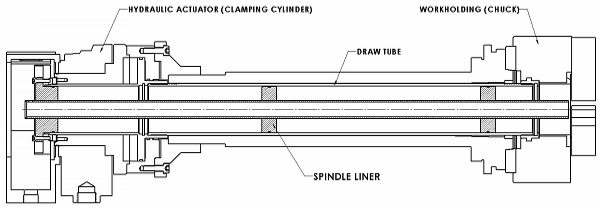
Spindle liners, also referred to as filler tubes, reduction tubes, master liners, or sleeves, reduce the inside diameter (I.D.) of a CNC lathe spindle to better support the bar being machined.
Clearance depends on the application and material, but spindle liners are typically sized approximately 0.030″ to 0.060″ over the diameter of the bar stock. By reducing excess space around the rotating bar, the correct spindle liner can help control bar movement, reduce vibration, support faster machining speeds, and improve tolerance consistency.
JF Berns manufactures machine-specific spindle liners for CNC lathes used with bar feeders, bar loaders, bar supports, bar pullers, and other bar-processing equipment.
With more than 40 years of application experience and a database representing more than 100,000 spindle liners manufactured, we can often identify what your machine needs with minimal information.
Find the Right Spindle Liner for Your CNC Lathe
A spindle liner is a relatively simple component, but getting the dimensions wrong can create unnecessary problems.
The liner needs to fit the machine correctly, provide appropriate clearance around the material, and mount securely to the spindle. That requires understanding more than the nominal diameter of the bar.
Depending on the application, we may review:
- CNC lathe manufacturer and model
- Bar diameter
- Actual bar outside diameter
- Bar length
- Material type and condition
- Draw tube I.D.
- Bar feeder or loader configuration
- Available retract space
- Existing JF Berns part number
- Required spindle liner I.D., when already known
- Other machine-specific constraints
Our machine database means we may already have the information needed for your lathe. If we do, you do not need to start from scratch measuring every component.
Have your machine make, model, and bar size ready when requesting a spindle liner quote.
How Does a Spindle Liner Work?
The purpose of a spindle liner is to reduce the open space between the bar stock and the inside of the spindle or draw tube.
Without adequate support, smaller-diameter stock can move significantly inside a larger spindle opening as it rotates. This movement can contribute to bar whip, vibration, noise, inconsistent machining, and unnecessary stress on the setup.
A properly sized liner keeps the material more closely supported while still providing enough clearance for the bar to feed freely.
The correct clearance is application dependent. For many applications, JF Berns spindle liners are sized approximately 0.030″ to 0.060″ larger than the bar diameter.
Actual bar dimensions matter. Nominal material size may not accurately represent hot-rolled, rough, oversized, or dimensionally inconsistent stock.
Spindle Liner Sizes and Specifications
Spindle liners should be selected around the machine and material being run rather than treated as universal tubes.
| Specification | Why It Matters |
|---|---|
| Lathe make and model | Helps determine machine-specific liner dimensions and mounting |
| Bar diameter | Establishes the general required liner I.D. |
| Actual outside diameter | Helps prevent insufficient clearance with oversized or inconsistent stock |
| Bar length | Can affect whether a standard or extended liner is appropriate |
| Draw tube I.D. | Helps determine available liner dimensions |
| Bar feeder or loader | Can affect liner length, access, and removal |
| Available retract area | Determines whether a full-length or two-piece liner can be installed |
| Existing part number | Makes replacement and additional-size ordering easier |
| Material condition | Can influence appropriate clearance |
If you already have a JF Berns spindle liner, provide the permanently marked part number when ordering another liner. We can use that information to identify the existing configuration and determine what is required for another bar size.
Ready to Install
JF Berns spindle liners are manufactured to arrive ready for the intended lathe application.
Applicable mounting holes and attachment hardware are included, so operators do not have to receive the liner and then determine how to drill or secure it themselves.
That matters because a spindle liner operates as part of a rotating system. Proper retention is not an optional detail.
Our liners are designed to be securely mounted to the back of the spindle rather than relying on an unsecured tube rotating inside the machine.
Permanently Marked Size and Part Number
 Each spindle liner is permanently marked with identifying information.
This gives operators a practical way to:
- Identify the correct liner for a job
- Reduce confusion when several liner sizes are stored together
- Match liners to recurring bar-stock applications
- Reorder an existing liner
- Communicate the correct JF Berns part number to purchasing or maintenance
For shops running multiple machines and bar diameters, simple identification can make spindle liner management considerably easier.
Extended Spindle Liners
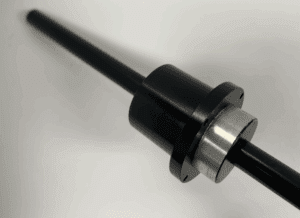 An Extended Spindle Liner can allow certain CNC lathes to run longer bars while supporting the material between the bar feeder and spindle. In general, an additional 12″ of bar-length capacity can be added to the lathe spindle.
Increasing usable bar length can improve material utilization and reduce unnecessary handling.
Potential advantages include:
- Longer usable bars
- Fewer preliminary cuts on 12′ bars, or whatever stock length is purchased
- Fewer short remnants
- Less avoidable material waste
- More efficient bar feeder use
- Support across the gap between the bar feeder and spindle
Extended liners are application specific. The machine, feeder configuration, available space, and required extension length all need to be considered.
If the spindle liner extends beyond the existing coolant collector, JF Berns can also provide an appropriate coolant collector or extension for the application.
Easy Out System
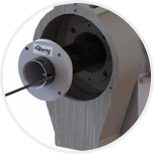 Removing a spindle liner should not become a maintenance project.
Most JF Berns spindle liners include our Easy Out System, which uses a short liner extension with a small cross hole. The operator can engage this hole with the JF Berns Easy Out Tool and gain additional leverage when removing the liner.
This is particularly useful when:
- The spindle is recessed behind machine guarding
- Access to the liner is limited
- The liner has remained installed for an extended period
- Operators frequently change between liner sizes
The Easy Out Tool and magnetic tool hanger are included with first-time lathe spindle liner orders.
The objective is straightforward: make the liner easier to remove without adding unnecessary complexity to the setup.
Quick Change Spindle Liners
For shops that regularly change bar diameters, the JF Berns Quick Change Spindle Liner System provides a faster way to exchange liners without loose screws or retaining rings.
The patented system uses a machine-specific adapter installed on the CNC lathe.
To install the liner:
- Insert the spindle liner through the adapter and into the lathe.
- Rotate the liner approximately 30 degrees in either direction.
- The system automatically locks the liner into position.
To remove it, pull the spring-loaded pin and reverse the process.
Each CNC lathe using the system requires one Quick Change adapter.
This configuration can be particularly useful for job shops and production environments where one lathe regularly processes several different bar diameters.
Two-Piece Spindle Liners
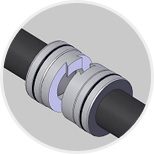 A full-length spindle liner is not practical on every CNC lathe.
When a bar feeder has limited retract space, there may not be enough room behind the machine to remove or install a conventional full-length liner.
JF Berns manufactures Two-Piece Spindle Liners, removable-part spindle liners, and Capped Spindle Liners for these applications.
Our standard two-piece design uses a dovetail-style connection that reduces the amount of space required to insert or remove the liner while creating a positive connection between the sections.
The right configuration depends on the lathe, bar feeder, and actual space available behind the machine.
Metal vs. Urethane Spindle Liners
Spindle liner material should also be evaluated based on the application.
Factors such as bar dimensions, liner wall thickness, coolant exposure, durability requirements, and machine configuration can influence which approach makes sense.
For a more detailed comparison, review our guide to metal spindle liners vs. urethane spindle liners.
If you are unsure which type is appropriate, provide the machine and material information with your quote request. We can review the application rather than forcing the setup into a one-size-fits-all recommendation.
Spindle Liners for a Wide Range of CNC Lathe Manufacturers
Our spindle liner database includes machine information covering a broad range of CNC lathe manufacturers.
Applications include machines from:
Ace, Aero, Alpha, Amera Seiki, Buildwell, Chandox, Chia Her, Chiron, Citizen, Clausing, Cybertec, Daewoo, DMG, Doosan, Emco Maier, Eurotech, Fortune, Ganesh, Gildemeister, Haas, Hainbuch, Hanwha, Hardinge, Hitachi Seiki, Howa, Hurco, Hwacheon, Hyundai, Index, Johnford, Khan, Kia, KSI, Leadwell, Matsumoto, Mazak, Mighty, Miyano, Monarch, Mori Seiki, Nakamura Tome, Nexturn, Nomura, Okuma, Riken, Rohm, Romi, Samchully, Star, Strong, Suhner, Takamaz, Takisawa, Tonfou, Traub, Tsugami, Wasino, Willemin-Macodel, Yama Seiki, YCM, Supermax, YCI, and others.
The presence of a manufacturer in our database does not mean one liner fits every machine that company produces. Spindle configuration, machine model, draw tube dimensions, and application requirements still need to be confirmed.
That is where having machine-specific historical data makes the ordering process easier.